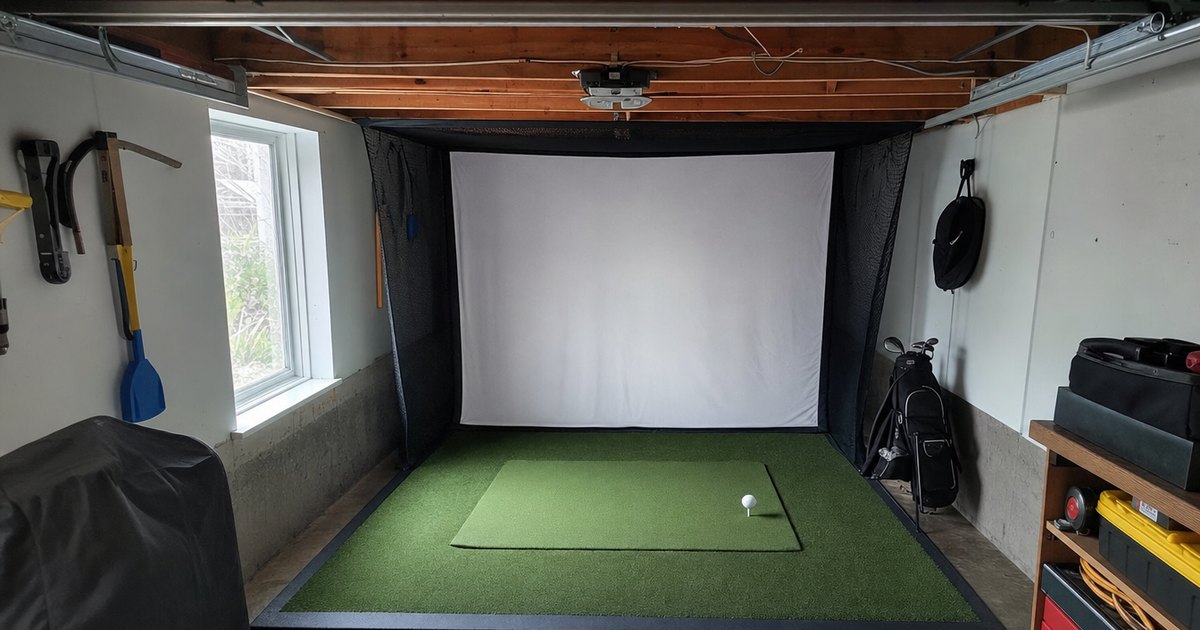
If you only read one thing before you build a garage golf simulator, make it this: the thing most likely to wreck your build isn’t your budget. It’s your ceiling.
I learned this with my wallet halfway out. I had the monitor picked, the enclosure in the cart, the projector bookmarked. What I had not done was stand in my garage with a driver and actually make a full swing while looking up. When I finally did, I went cold. The clubhead came within a few inches of the trusses at the top of the backswing. A full, committed driver swing? No chance. I’d have been clipping the ceiling — or worse, swinging tentatively to avoid it, which trains a swing you don’t want.
Why ceiling height is the silent killer
Budget problems announce themselves. You can’t afford something, so you don’t buy it. Simple. Ceiling problems hide until the gear is already in the room, because everyone measures the floor and almost nobody measures the swing.
The full-swing arc is taller than people think. It’s not just your height plus the club. At the top of the backswing the clubhead is well above your hands, and at the finish it’s up over your lead shoulder. Then there’s the ball flight clearance — even a few feet of launch in front of you needs vertical room before the ball reaches the screen, or you’re hitting low line drives into the bottom of your impact screen forever.
So a garage with a “normal” 8-foot ceiling is genuinely tight for a tall player with a driver, and a low 7-foot-something basement is often a no-go for full swings no matter how much you spend.
The two clearances nobody separates
When I talk about ceiling height now, I split it into two different problems:
- Swing clearance: can you physically complete a full backswing and follow-through without hitting the ceiling? This is about you — your height, your arm length, your club.
- Ball-flight clearance: does the launched ball have room to rise on its way to the screen, so the screen catches a realistic flight instead of a punch shot? This is about the room geometry between you and the screen.
A space can pass one and fail the other. I’ve seen builds where the swing just fits but every shot slams into the bottom third of the screen because there’s no vertical room for the ball to climb. The numbers look fine on the launch monitor; the experience is miserable.
The mistakes I see again and again
Spend any time in the home-sim forums and the same ceiling stories cycle through every few weeks. A few patterns:
Measuring to the joist, not the obstruction. People measure to the ceiling and forget about the garage door track, the opener rail, the light fixtures, the ductwork. Your swing doesn’t care that the drywall is at 9 feet if the opener rail hangs down to 7’8” right where the club comes through. Measure to the lowest thing in the swing path, not the ceiling.
Forgetting they’ll stand on a mat. A thick hitting mat raises you up an inch or two, and that comes straight off your ceiling clearance. It sounds trivial until you’re the player whose driver was clearing by an inch before the mat went down.
Assuming a slower swing fixes it. Some people figure they’ll just “swing easy” indoors to avoid the ceiling. That’s how you train a tentative, decelerating move you then take to the course. A sim should let you make your real swing. If the room forces a fake one, the room is too small for that club — full stop.
Buying for the swing they wish they had. Plenty of builds get sized around a compact, shut-down swing the owner doesn’t actually own. Build for your real arc, on a real full send, not the tidy half-swing you make when someone’s watching.
What I’d check before spending a dollar
Stand where you’ll hit. Make a slow full driver swing and have someone watch the clubhead at the top and the finish. Note the gap to the ceiling. Then think about whether the ball has room to rise toward the screen. If either is tight, you have real decisions to make — and they’re decisions about space, not gear.
If the ceiling is genuinely too low for a driver, you’re not necessarily out. Plenty of people run a great iron-and-wedge sim and just don’t hit driver indoors. That’s a completely valid build — but it’s a decision you want to make on purpose, before the money’s spent, not discover after the enclosure’s up.
This is exactly why I built a space planner into the site: you put in your room dimensions and ceiling height and it flags the swing-clearance and ball-flight problems before you buy. Use the sim space planner first. Standing in the garage looking up at the trusses is a fine gut check, but the planner makes it honest.
Buy the space, then the gear
The order most people use — pick the gear, then squeeze it into the room — is backwards. Measure the space, decide what swings the room can actually hold, then choose gear that fits that reality. A modest budget in a room that fits is a sim you’ll use every winter. A premium budget in a room that doesn’t fit is a swing change you’re scared to make and an impact screen full of low liners.
Once you know what your room can hold, picking the unit gets a lot simpler. I sorted the affordable end of that by what actually works in a real garage in the best budget golf simulators guide. But measure first. The ceiling decides more than the price tag ever will.