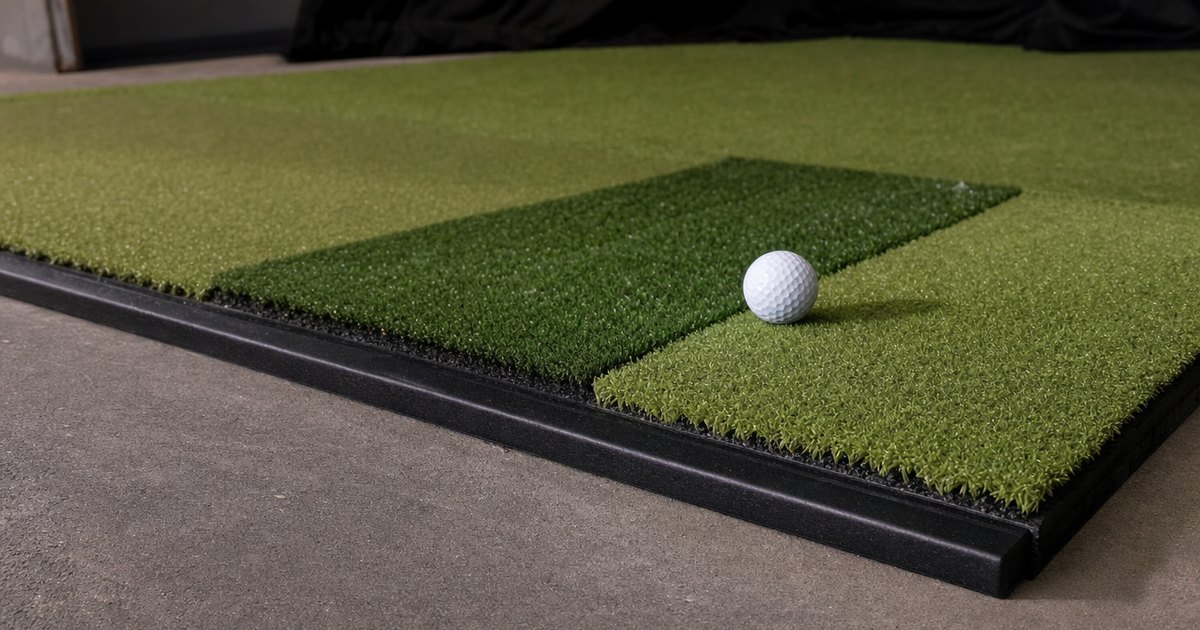
Of all the pieces in a home sim, the mat is the one people treat as an afterthought — and it’s the one that hurt me most, in two completely different ways. It bothered my joints, and it quietly corrupted the data I was building a swing on. So let me make the case for the unglamorous purchase.
The wrists came first
My first mat was thin, hard, and cheap. On a clean strike it was fine. But I don’t hit clean every time — nobody does — and on the fat shots, the ones where the club bottoms out behind the ball, all that energy that would have dug a divot on grass had nowhere to go. It came straight back up the shaft into my hands, my wrists, my elbows.
A few weeks in, my lead wrist ached after every session and my elbows were grumbling. I assumed it was technique, or volume. It wasn’t. It was the mat. A hard mat punishes the exact mishits you’re in the garage to fix, and it punishes them in your joints. That’s a fast way to develop a flinch — or an injury that keeps you off the course entirely.
Then I noticed the data was lying
The second problem was sneakier. A cheap mat doesn’t just hurt — it changes how the club interacts with the surface, and that changes your data.
On a hard, low-friction mat, the club can bounce into the ball on a slightly fat strike instead of digging, turning what should have been a chunk into a passable-looking shot. So the mat was hiding my mishits. The launch monitor dutifully reported the cleaner result, and I got a flattering picture of a strike that wasn’t really there. I was practising on data that had been quietly improved by my equipment — which is just a different flavour of the calculated-spin trap that started this whole site: numbers that look real and aren’t telling you the truth.
A good mat behaves more like turf. It lets the club interact honestly, so a fat shot reads like a fat shot and your data reflects what you actually did. You can’t fix a strike the equipment is hiding from you.
What I learned to look for
I’m not here to bench-test mats — I haven’t, and I won’t pretend to. But from living with a bad one and then a good one, here’s what actually mattered:
- Enough cushioning to protect your joints on the fat ones, without being so soft it feels nothing like grass.
- A surface that lets the club interact realistically — that reads a fat strike as fat instead of bouncing it clean.
- Consistency across the surface so your strike feedback doesn’t change depending on exactly where the ball sat.
- Durability, because you’ll hit thousands of balls from the same spot and a cheap mat wears into an uneven, even-harder surface.
The throughline is that the mat is the one piece touching your body on every single shot, and the one shaping the strike your data is built on. That’s not where to save fifty bucks.
The hidden cost: it changes your swing too
The wrists and the data were the obvious problems. The sneaky third one took me longest to notice: a bad mat quietly changes how you swing.
When a hard mat punishes every fat strike, your body is smart — it learns to avoid the pain. So you start picking the ball, hovering the low point, swinging up to skim the surface instead of hitting down and through it. That’s a fault you then carry to the course, where the ground does not forgive a picker. I’d built a little flinch into my contact without ever deciding to, purely because the mat made proper turf interaction hurt. A mat that behaves more like grass lets you make a real, descending strike without bracing for impact, so the swing you groove indoors is the swing you actually want outdoors.
What about hitting off a real divot tray?
People ask whether a fancy divot-action mat or a real-turf insert is worth it over a plain mat. My honest take, without pretending I’ve bench-tested every option: the more realistically the surface lets the club interact — taking something like a divot, reading a fat shot as fat — the more honest your strike feedback and your data. Whether that’s worth the extra cost depends on how seriously you’re working on contact. If you’re mostly there to play courses and train speed, a good consistent mat is plenty. If you’re grinding on strike quality and want your indoor data to mirror grass, a more turf-like surface earns its keep. Either way, the floor of acceptable is “won’t hurt my joints and won’t hide my mishits” — below that, it’s a false economy.
Where it fits in the build
I put the mat right up there with the launch monitor in importance — the monitor is the brain, the mat is what keeps your body healthy and your data honest enough for the brain to be worth anything. Spend accordingly. It’s not the fun purchase, but it’s the one I’d refuse to cut.
When I rebuilt my bay properly, the mat went in alongside the screen, net and enclosure as part of one considered kit rather than a last-minute add-on — I pulled all of that together in the best golf simulator enclosures guide. Protect your wrists and keep your data honest. The mat does both, or it does neither.