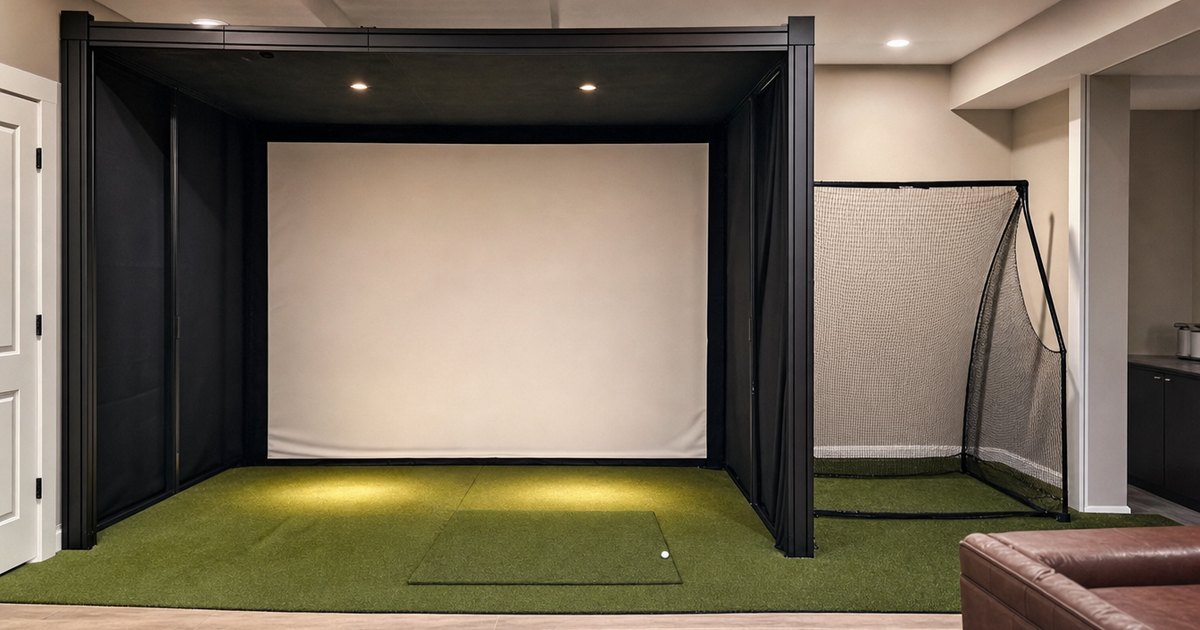
For a long time I was a net guy and proud of it. A good hitting net plus a mat and a launch monitor is a genuinely complete way to practise — you hit real shots, you get real numbers, and it costs a fraction of a full bay. So I want to be fair to the net before I tell you why I eventually built the enclosure.
What the net did well
The net got me hitting immediately and cheaply. I could collect data all winter, work on speed and strike, and groove a swing without leaving the garage. For pure practice — feedback on ball speed, launch, strike quality — a net-and-monitor setup gives you most of what matters. If your goal is to get reps and watch your numbers, you can be very happy here for a long time. I was.
The net also asked less of my space. No projector throw to solve, no screen to tension perfectly, less to go wrong. It’s the lower-stress build, and there’s real value in that.
What the net couldn’t do
What the net could never give me was the picture. You hit into a net and the ball flight ends there. You see the number, but you don’t see the shot — no fairway, no target, no consequence, no course. And it turns out that picture does more than look nice:
- Targeting and shot shaping got vague. Without a flight to watch and a target to aim at, I’d drift into mindless ball-beating. The screen gives every shot somewhere to go.
- Real-feeling rounds were impossible. I could practise, but I couldn’t play. No driving a hole, no laying up, no putting it together under a bit of self-imposed pressure.
- Engagement quietly faded over a long winter. Hitting into a net is great for a focused session and a slog for two hours. The screen kept me in there longer and made the time fly.
The day I knew it was time
The tipping point wasn’t a single feature. It was noticing that I’d started skipping garage sessions because “just hitting into the net again” had lost its pull. The data was still useful, but the fun had leaked out. I realized I’d outgrown practice-only and wanted to actually play.
That’s the honest signal to upgrade, in my experience: not when you can afford it, but when the net has stopped pulling you into the garage and you find yourself wanting consequence, courses, and a shot you can watch.
What the enclosure changed
Building the full enclosure — frame, impact screen, projector — turned the room from a practice station into a place I actually wanted to spend a winter evening. Suddenly I was playing courses, working on shots with a target, and staying in there far longer. My practice got better too, because targeting on a screen sharpened the aimless ball-beating into something with intent.
It also asked more of me. The enclosure is the build where ceiling height and ball-flight clearance really matter — the ball needs room to rise toward the screen, and the projector needs its throw. This is the stage where measuring the room first pays off, and where I’d send you to plan the space before you buy a frame you can’t swing under.
What surprised me about the upgrade
A couple of things about the enclosure caught me off guard, and they’re worth passing on.
First, the enclosure is louder than the net, in a good way and a bad way. A ball thumping an impact screen makes a deeper, bigger sound than a net’s soft catch. In an attached garage under a sleeping house, that’s a real consideration — I had to think about timing my sessions in a way I never did with the net.
Second, the enclosure exposed every space problem I’d gotten away with on the net. With a net, low shots just hit the net low and you shrug. With a screen, low shots hit the bottom of the screen and look terrible, and suddenly the ball-flight clearance I’d been ignoring mattered a lot. The enclosure raised the bar on the room itself, not just the gear.
Third — and this is the happy surprise — I practised more, not less. I’d assumed the screen would make me lazy, all playing and no working. The opposite happened. Having a target to aim at on screen made my practice more focused than mindlessly filling a net ever did. The picture didn’t replace the practice; it sharpened it.
Don’t skip the net stage
One thing I’d push back on: the temptation to jump straight to a full enclosure and skip the net entirely. I get it — the bay is the dream. But the net stage taught me things I’d never have learned spending the same money all at once. It taught me I’d actually use the thing through a winter. It let me sort out my space, my mat and my monitor before I added the complexity of a screen and projector. And it spread the cost so the whole build never felt like one terrifying purchase. The net isn’t a consolation prize on the way to an enclosure; it’s the smart first half of the same build.
So which should you build?
- Net + mat + monitor: if your goal is practice, feedback and reps, and you want the cheaper, lower-stress build — start here, and you may be happy for years. It’s a complete way to train.
- Full enclosure: when you want to play, not just practise — courses, targets, a shot you can watch, and a room that pulls you in on a cold night. It costs more and asks more of your space, but it changes the whole experience.
The staged path — net first, enclosure when the net stops pulling you in — is the one I’d recommend to almost everyone, because it spreads the cost and lets you confirm you’ll use it. When you’re ready for the bay, I weighed up the frames, screens and complete kits in the best golf simulator enclosures guide. Upgrade when the fun leaks out of the net — that’s the real signal.