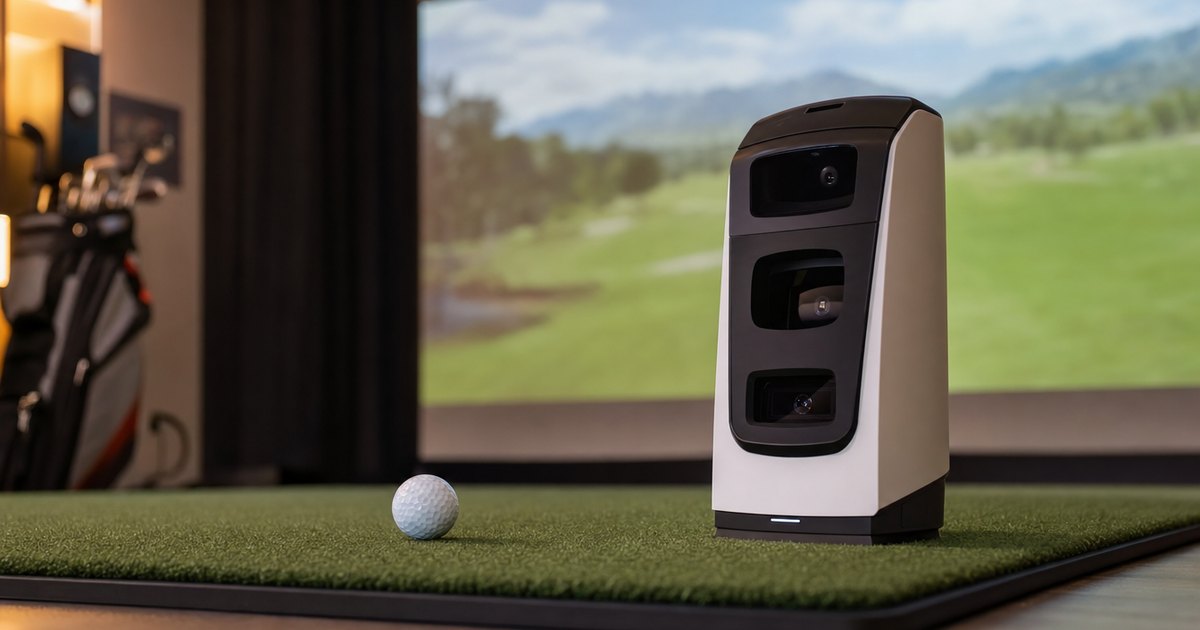
I want to start this whole site with the mistake that built it. Because it’s the reason I care so much about one boring-sounding distinction: whether your launch monitor measures a number or calculates it.
Here outside Columbus, the golf season basically dies in November and doesn’t come back until April. So a few winters ago I built a garage simulator to keep practising. Mat, net, screen, projector, and a cheap launch monitor feeding the sim software. I was thrilled. I could hit balls in January. What I didn’t understand was that the unit I’d bought measured my ball speed and then estimated my spin from it. It never actually saw the ball spinning.
The number that looked precise and was wrong
Here’s the trap. The spin number on the screen looked exactly as real as everything else. Same font, same decimal places, updating shot to shot. There was no little asterisk saying “we made this one up.” So I trusted it.
And the spin it showed me was high. Ballooning-high on my 7-iron, the kind of number that says you’re delofting wrong, releasing early, spinning the ball into a parachute. So all winter I worked on a flatter, more compressed strike to bring that spin down. I changed my grip pressure. I moved the ball back. I shallowed everything out chasing a lower number.
It felt like progress because the number went down. That’s the cruel part — the calculated spin obediently dropped, because I’d changed the ball speed and launch it was derived from. I was teaching the formula, not improving my golf.
The fitting that blew it up
In the spring I went for a club fitting, on a proper photometric unit that actually measures spin off the ball’s dimples. My real 7-iron spin was nothing like what I’d been chasing in the garage. It had never been the problem. I’d spent four months rebuilding a swing around a number a cheap algorithm had guessed.
I came home and sat in the garage and just stared at the screen. Every shot it showed me was real ball speed and a story about spin. I’d believed the story.
What I actually understand now
Ball speed is easy to measure directly — Doppler radar or a camera can clock the ball leaving the face honestly. Spin is the hard one. To truly measure spin, a unit has to either see the ball’s markings rotate (photometric) or read the way the ball’s own micro-features modulate a radar return over distance. Cheaper units skip that and infer a spin figure from ball speed and launch using a model. For a tour-average swing the model can land close. For your swing, on a mishit, with your ball, it can be way off — and you have no way to know which shots it nailed and which it invented.
The lesson isn’t “cheap monitors are useless.” A unit that honestly measures ball speed, club speed and launch is genuinely useful for speed training and tempo work. The lesson is: know which of your numbers are measured and which are calculated, and never build a swing change on a calculated one. If a number is going to send you to the grip and the ball position and the shaft, it had better be a number the machine actually saw.
Why the cheap unit wasn’t “broken”
Here’s the thing I want to be fair about: the monitor wasn’t defective. It did exactly what it was built to do. It measured my ball speed honestly and then ran that through a model to produce a spin figure. For a golfer whose swing happened to match the model’s assumptions, on a clean strike, with the right ball, that figure might have been close. The unit never lied to me about what it was — I just never asked. The box didn’t shout “spin is estimated.” It showed me ten numbers and I treated all ten as equally earned.
That’s the part that still bothers me. The failure wasn’t the hardware; it was that I didn’t understand the difference between a number a machine observes and a number it infers. And nothing on the screen draws that line for you. The decimal places look identical. The update rate looks identical. Only the underlying method is different, and the method is exactly the thing a beginner doesn’t think to check.
What the bad winter actually cost
It wasn’t just the wasted practice hours, though there were a lot of those. The deeper cost was that I’d grooved a swing change my body didn’t need. Coming back from a flatter, more “compressed” move that was chasing a phantom problem took longer than the winter I’d spent installing it. I had to un-learn before I could re-learn. For a few months my real golf was worse than before I built the sim — which is a brutal outcome for a guy who built a garage simulator specifically to get better over the winter.
The only good thing to come out of it is this site. I got obsessed with the measured-versus-calculated line precisely because I’d paid for ignoring it, and I didn’t want anyone else handing a whole winter to a number that was never real.
How I’d tell my past self to buy
If spin matters to how you practise — and for iron flighting and wedge control it matters a lot — that’s the one parameter you pay to get measured, not guessed. Everything else can be more forgiving. I’d rather have a unit that measures three things honestly than one that displays ten numbers and only earned half of them.
These days I look at any monitor through that filter first: what does it actually measure, by what method, and what is it quietly deriving? It changes how the whole price ladder reads. The jump in price between tiers is usually buying you real spin measurement and tighter accuracy bands — not more decimal places on a guess.
I put everything I’d want to know about which units genuinely measure spin into the best launch monitors for spin guide — sorted by data method, not by marketing. If you take one thing from my expensive winter: a precise-looking number can still be a made-up number, and your swing can’t tell the difference. You have to.